/*
 * Approximate SDF of a heightfield.
 * Positive outside the surface, negative inside.
 */
float SDFHeightfield(float3 p) {
    return sampleHeight(p.xz) - p.y;
}

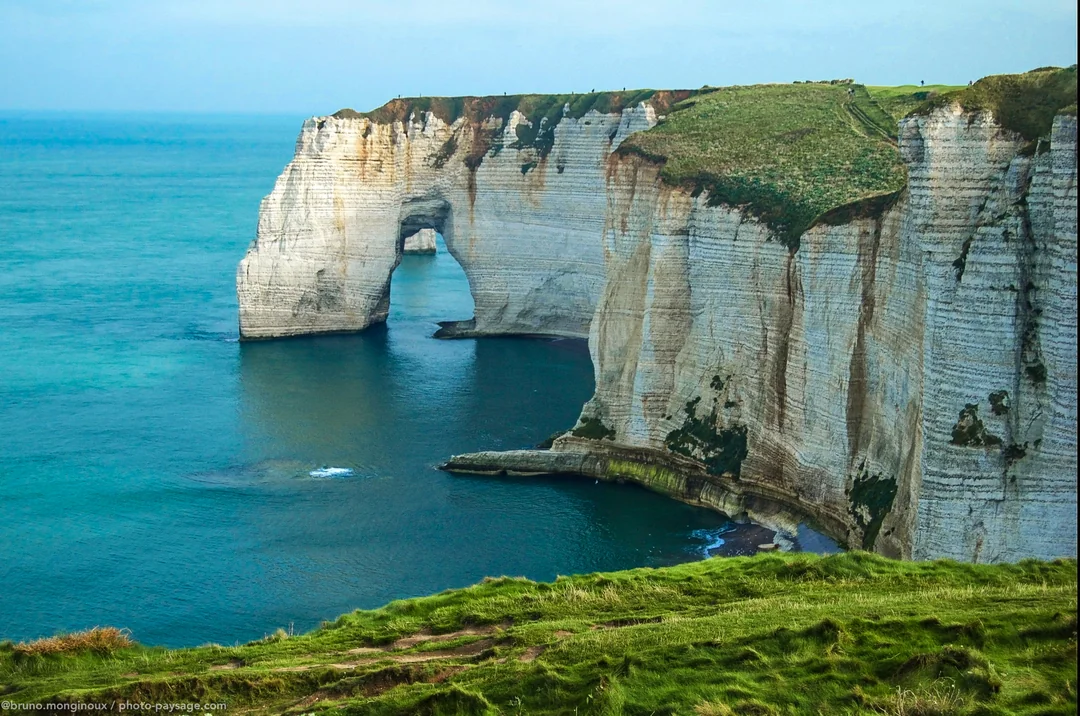
public class CoastalErosionSettings {
    // Minimum slope for the seed to be accepted
    public float seedMinSlope;

    // Acceptable altitude range for seeds
    public Vector2 seedElevationRange;

    // A random probability of acceptance for more variety
    public float seedAcceptanceProbability;

    // Sphere radii will be randomly computed from this min, max range
    public Vector2 radiusRange;

    // Number of carving step per seed, randomly within this range
    public Vector2Int growthStepRange;

    // Number of sphere carved at each growth step
    public Vector2Int growthSphereRange;
}

// Characterization of a seed point.
public class SeedPoint {
    public Vector3 point;
    public Vector3 normal;
}

/*
 * Compute the set of seeds for coastal erosion from the base heightfield.
 * Scan the heightfield and look for the steep parts around sea elevation.
 */
public List<Vector3> GetCoastalErosionSeeds(CoastalErosionSettings settings, ...) {
    List<Vector3> ret = new List<Vector3>();
    for (int x = 0; x < terrain.Width(); x++) {
        for (int y = 0; y < terrain.Height(); y++) {
            Vector3 point = terrain.Point(x, y);

            // Altitude
            if (!Utils.WithinRange(point.y, settings.seedElevationRange))
                continue;

            // Slope
            float slope = terrain.GetSlope(x, y);
            if (slope < settings.seedMinSlope)
                continue;

            // Probability
            float p = Random.value;
            if (p > settings.seedAcceptanceProbability)
                continue;

            ret.Add(new SeedPoint(point, terrain.Normal(x, y)));
        }
    }
    return ret;
}

/*
 * Returns a set of spheres more or less randomly positioned along a direction.
 */
public List<Sphere> GrowFromSeed(Vector3 seed, Vector3 direction, CoastalErosionSettings settings, ...) {
    List<Sphere> ret = new List<Sphere>();
    ret.Add(new Sphere(seed, Utils.RandomRange(settings.radiusRange)));

    // Growth dir slightly downward, and globally horizontal
    Vector3 growthDir = new Vector3(direction.x, -0.1f, direction.z);

    // Sphere positioning loop
    Vector3 p = seed;
    int nbStep = Utils.RandomRange(settings.growthStepRange);
    for (int i = 0; i < nbStep; i++) {
        // Random amount of sphere at each step around p, each with random radii
        int nbSpheres = Utils.RandomRange(settings.growthSphereRange);
        var newSpheres = Utils.RandomSpheresAroundPoint(p, nbSpheres, settings.radiusRange);
        ret.AddRange(newSpheres);

        // Move along direction
        p = p + direction;
    }
}

/*
 * Perform the coastal erosion algorithm. Returns a set of spheres that should be carved out of the
 * base heightfield in implicit form.
 */
public List<Sphere> CoastalErosion(CoastalErosionSettings settings, ...) {
    // Get seeds
    var seeds = GetCoastalErosionSeeds(settings, ...);

    // Carving with spheres, in the normal direction
    List<Sphere> ret = new List<Sphere>();
    foreach (var seed in seeds) {
        var newSpheres = GrowFromSeed(seed.point, -seed.normal, settings, ...);
        ret.AddRange(newSpheres);
    }

    return ret;
}
float3 Warp(float3 p) {
    return p + float3(1, 0, 0); // constant offset
}

float SDF(float3 p) {
    float3 q = Warp(p):
    ... // we continue with the rest of the implicit function
}
// Your typical perlin or value noise
float3 Noise(float3 p) {
    ...
}

float3 Warp(float3 p) {
    // Warp amplitude from 1D noise
    float w = Noise(float3(0.0f, p.y, 0.0f) * frequency) * amplitude;

    // Warp direction, from the base heightfield
    float3 d = HeightfieldGradient(p);
    d = float3(d.x, 0.0f, d.z);

    // Final warp
    return p + d * w;
}

float SDF(float3 p) {
    float3 q = Warp(p):
    ...
}
![Planar models can be built in different ways: for instance using an analytic function (left), or interpolation across discrete samples (right). Figure from [1].](../images/blog/volumetric_terrain_modeling/ld/heightfieldModels.webp "Planar models can be built in different ways: for instance using an analytic function (left), or interpolation across discrete samples (right). Figure from [1].")